USD
USD INR
INR
Call Us Now
+91 9106756572
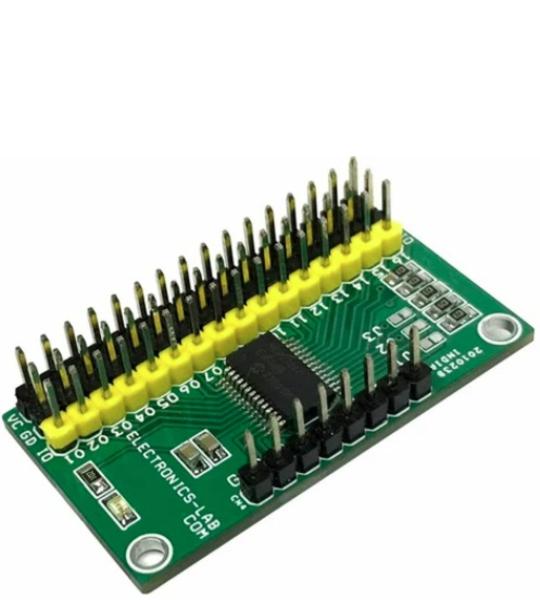
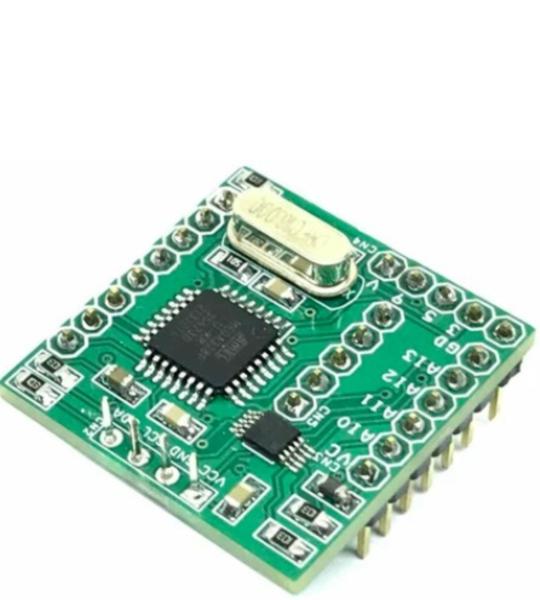
This module provides 16-bit, general-purpose parallel I/O expansion for I2C or SPI bus applications. The MCP23017 chip supports the I2C interface and the MCP23S17 chip is used for the SPI interface. The board can be populated with either SPI or I2C chip. Follow the connection diagrams for interface details.
C111
This module provides 16-bit, general-purpose parallel I/O expansion for I2C or SPI bus applications. The MCP23017 chip supports the I2C interface and the MCP23S17 chip is used for the SPI interface. The board can be populated with either SPI or I2C chip. Follow the connection diagrams for interface details.
MCP23X17 consists of multiple 8-bit configuration registers for input, output and polarity selection. The system host can enable the I/Os as either inputs or outputs by writing the I/O configuration bits (IODIRA/B). The data for each input or output is kept in the corresponding input or output register. The polarity of the Input Port register can be inverted with the Polarity Inversion register. All registers can be read by the system host. The 16-bit I/O port functionally consists of two 8-bit ports (PORTA and PORTB). MCP23X17 can be configured to operate in the 8-bit or 16-bit modes via IOCON.BANK. There are two interrupt pins, INTA and INTB, that can be associated with their respective ports, or can be logically OR ’ed together so that both pins will activate if either port causes an interrupt. The interrupt output can be configured to activate under two conditions (mutually exclusive):
The Interrupt Capture register captures port values at the time of the interrupt, thereby saving the condition that caused the interrupt. The Power-on Reset (POR) sets the registers to their default values and initializes the device state machine. The hardware address pins are used to determine the device address.
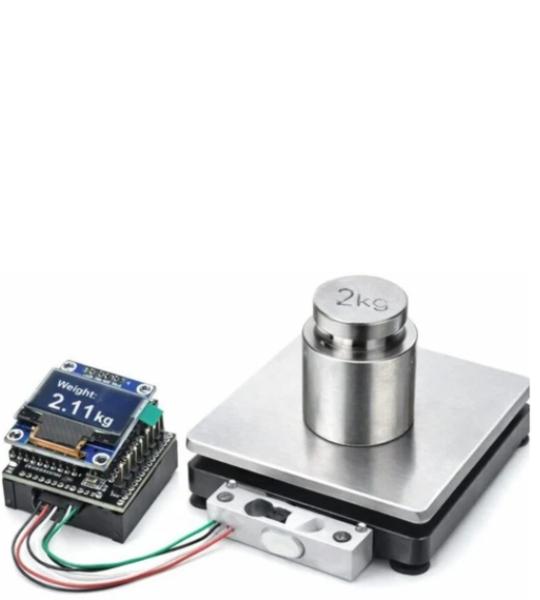
This compact shield is based on the HX711 ADC, specifically designed to interface load cells and strain gauge sensors. It can be paired with the OLEDUINO-V2, enabling the creation of a miniature electronic weighing scale.
This board consists of Arduino-compatible hardware which includes an OLED display, ADS1115 4-Channel 16Bit ADC, Arduino-compatible Microcontroller ATMEGA328, a connector for Arduino Programming, a connector for 4 Channel Analog input, and a connector for a couple of I/O lines. Operating supply 5V DC.
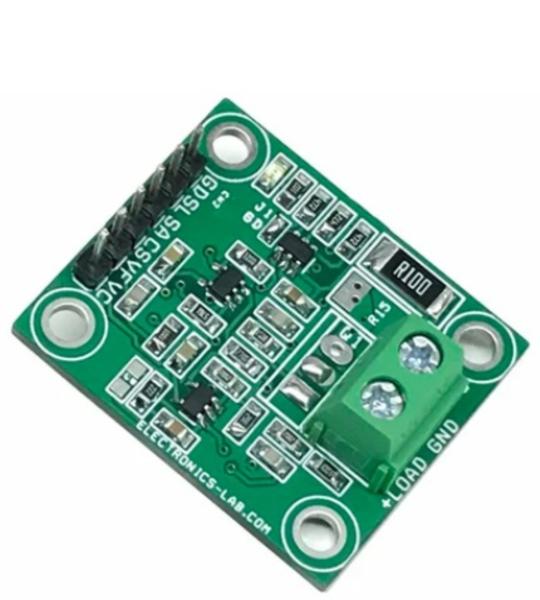
This is an I2C electronic load, intended for testing power supplies, solar panels, batteries, and supercapacitors. The board consists of an I2C interface DAC MCP4725, OPAMP U2 acts as V to I (Voltage to Current), OPAMP U3 measures the load current across the shunt resistor and provides 0 to 4.9V Voltage with a current range of 0 to 1A. Users may control the battery discharge current using the MCP4725 DAC in the range 0 to 1A. The circuit also provides load current feedback and voltage feedback. This way it can help users to measure the battery’s performance. Suppose the user desires to measure the battery’s performance as it is being discharged at constant power. In that case, a current measuring circuit can be used in the feedback loop to enforce the constant power constraint. This enables you to discharge a battery at a controlled way. The project can handle 1A @ 24V, thus a total of 24W with the use of a large-size heatsink and fan. The circuit works with 5V DC voltage input. The project can be used with Arduino, ESP32, or other microcontroller.
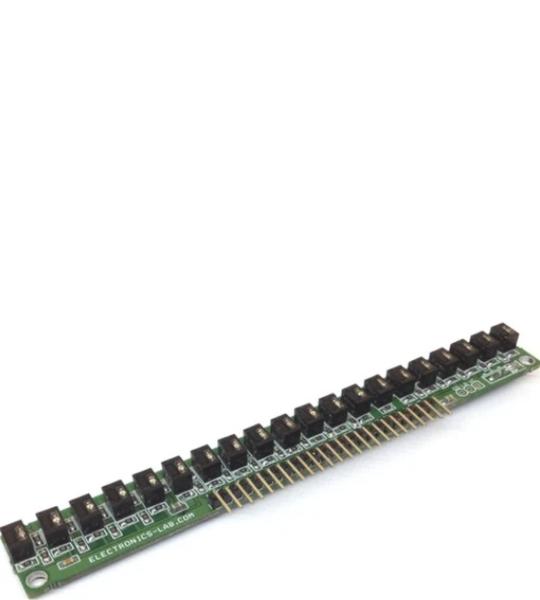
Product consists of 20 non-contact infrared reflective sensors and each sensor provides an analog output. QRD114 sensor is the heart of the project which includes Infrared LED and photosensor. The output of each sensor is high and goes low as objects or lines detected. The analog output voltage is proportional to IR reflected back to the sensor. The project has been designed to be used in robotics applications for line follower or multi-object sensor. Sensor requires 5V DC to work, all LEDs have current limiting resistors, each output has a pull resistor, and the normal output of each sensor is high due to the pull-up resistor and goes low as object or line is detected. IR LEDs power ON/OFF can be controlled using Q1 BD140 PNP BJT transistor which requires a low voltage for normal operation or all IR LED and can be powered up to 5V DC with help of VL input pin. Two 3mm mountings provided for easy mounting on robot chassis. By reflected infrared light, it can detect transitions from light to dark or any objected comes across the sensor.
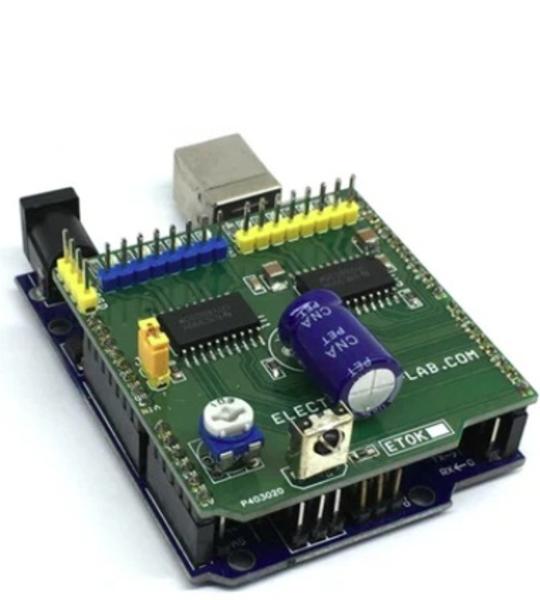
The 8 Channel Driver Arduino UNO Shield is designed to enable users to switch inductive loads for up to 800mA each channel and up to 24V DC with no heat-sink needed. It is ideal for such applications as driving 2x unipolar stepper motors, solenoids, relays, and small DC motors. It uses 2x DRV8803 Chip from Texas instruments which is 4 channel low side driver with over current protection. IC’s Internal shutdown protection function is provided for overcurrent protection, short circuit protection, under-voltage lockout, and over temperature. Faults are indicated by a fault output pin that is normally high and goes low if a fault condition occurs. Reset and enable pins has internal pull-down resistors.
Cookie preferences