USD
USD INR
INR
Call Us Now
+91 9106756572
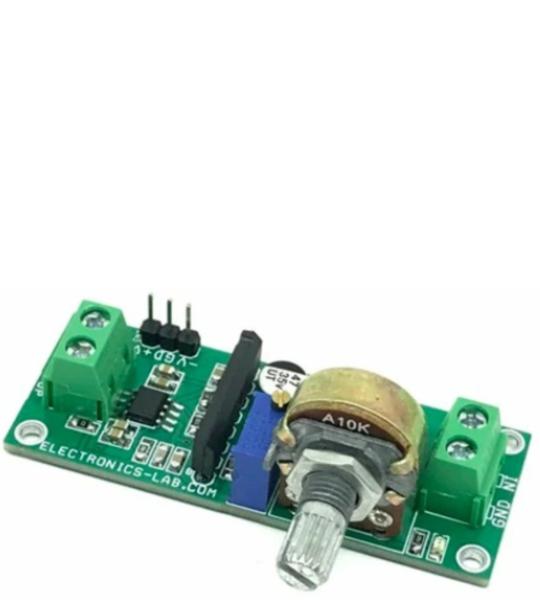
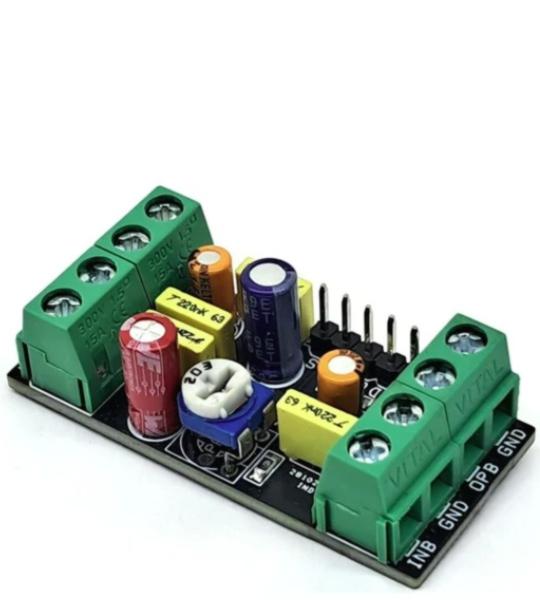
This is a Voltage Controlled Amplifier (VCA). A VCA board helps users control the Audio Level from a remote potentiometer. It requires a single-ended audio signal in the input. Gain control voltage can be adjusted through an on-board potentiometer or use an external potentiometer connected to CN4. The project works with a dual ±15V power supply. Screw terminal connectors are provided for signal input and signal output. The project is built using THAT2181LA chip, a VCA that is designed for high-performance audio-frequency applications requiring exponential gain control, low distortion, wide dynamic range, and low control-voltage feedthrough. These parts control gain by converting an input current signal to a bipolar logged voltage, adding a DC control voltage, and re-converting the summed voltage back to a current through a bipolar antilog circuit. Stereo control of VCA with a single potentiometer is possible.
This is a Voltage Controlled Amplifier (VCA). A VCA board helps users control the Audio Level from a remote potentiometer. It requires a single-ended audio signal in the input. Gain control voltage can be adjusted through an on-board potentiometer or use an external potentiometer connected to CN4. The project works with a dual ±15V power supply. Screw terminal connectors are provided for signal input and signal output. The project is built using THAT2181LA chip, a VCA that is designed for high-performance audio-frequency applications requiring exponential gain control, low distortion, wide dynamic range, and low control-voltage feedthrough. These parts control gain by converting an input current signal to a bipolar logged voltage, adding a DC control voltage, and re-converting the summed voltage back to a current through a bipolar antilog circuit. Stereo control of VCA with a single potentiometer is possible.
THAT 2181-series trimmable Blackmer voltage-controlled amplifier (VCAs) ICs are very high-performance current-in/current-out devices with two opposing-polarity, voltage-sensitive control ports. They offer wide-range exponential control of gain and attenuation with low signal distortion.
The trim should be adjusted for minimum harmonic distortion using PR1. This is usually done by applying a middle-level, middle-frequency signal (e.g. 1 kHz at 1 V) to the audio input, setting the VCA to 0 dB gain, and adjusting the SYM trim while observing THD at the output. In THAT2181LA, this adjustment coincides closely with the setting which produces minimum control-voltage feedthrough, though the two settings are not always identical.
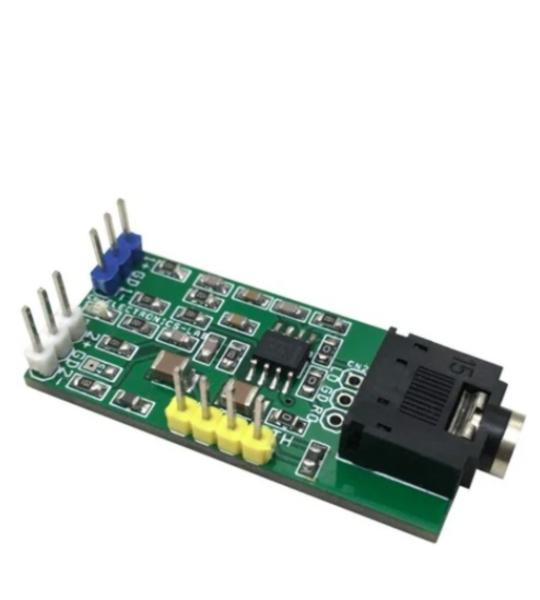
This is a headphone amplifier project for audio digital-to-analog converters (DACs) with differential voltage outputs. This circuit converts the differential voltage output of the DAC to a single-ended, ground-referenced signal and provides the additional current necessary for low-impedance headphones. Project is built using OPA1688 low distortion, high-drive Sound Plus audio amplifier. The circuit tested with dual +/-5V DC supply, and it can drive a load 16 Ohms to 600 Ohms. Headphone amplifier provides an output 50mW into 32 Ohms. Signal for the right channel and left channel input is applied to the amplifier through connectors CN1and CN3, respectively.
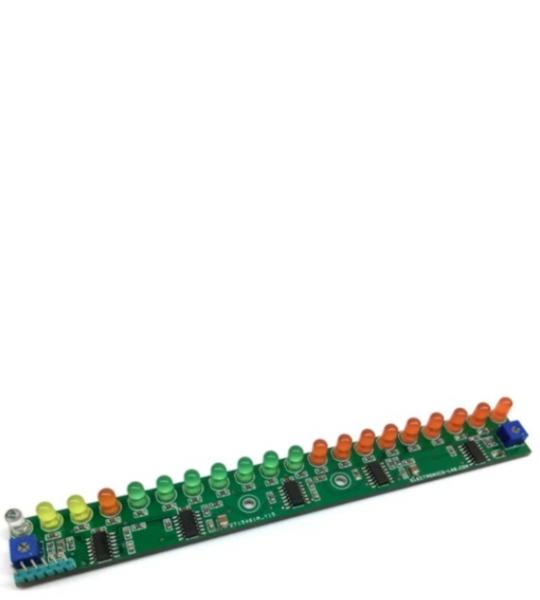
This is an “Audio VU Meter” or “Sound Level Meter”, it is a general-purpose bar-graph Audio VU meter designed for fun projects. All you need is to hook up one wire to the output of the audio amplifier’s speaker pin along with GND and see the magic. The response of the circuit is very fast and it provides beautiful visual representation from audio input signal.
This simple project is an audio limiter based on the NJM2761 chip. It provides effective protection for speakers by limiting the audio signal level. The limit level is adjustable through an external trimmer potentiometer (PR1).
This Audio Processor designed using TDA7440 chip from ST. The chip is a volume tone (bass and treble) balance (Left/Right) processor for quality audio applications in Hi-Fi systems. A selectable input gain is provided. Control of all the functions is accomplished by serial bus I2C. The AC signal setting can be altered by resistor networks and switches combined with operational amplifiers.
This is a 2Vrms Pop-Free stereo line driver with a stereo headphone driver designed to allow the removal of the output DC-blocking capacitors for reduced component count and cost. The project is based on the DRV604 chip which is ideal for single supply electronics where size and cost are critical design parameters. The project is capable of driving 2Vrms into a 5kΩ load and a clean 40mW into a 32Ω headphone with a single 3.3V supply voltage. Line and headphone outputs have ±8kV IEC ESD protection. The device has built-in shutdown control for pop-free on/off control. The DRV604 does not require a power supply greater than 3.3V to generate its 5.6Vpp output, nor does it require a split rail power supply. The DRV604 integrates its charge pump to generate a negative supply rail that provides a clean, pop-free ground biased 2Vrms output. This project is configured with single-ended header input connectors for analog input, headphones, and line output. The power supply is connected via a four-pin 2.54mm pin header.
Cookie preferences